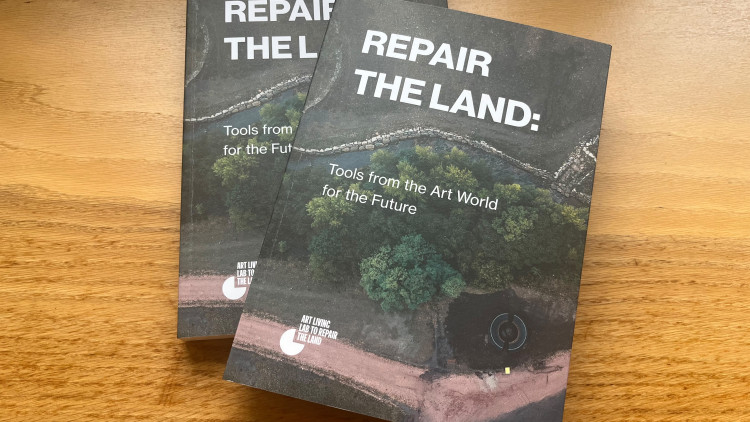
Launching the book "REPAIR THE LAND: Tools from the Art World for the Future"
Download your digital copy down below
We are delighted to announce the launch of REPAIR: Tools form the Arworld for the Future, a publication that brings together the knowledge, experiences and creative processes developed throughout the second edition of Art Living Lab.
What happens to a territory when the industries that once sustained it disappear? What remains after decades of intensive resource exploitation? And, perhaps most importantly, how can local communities take an active role in shaping new futures for these landscapes?
These are some of the questions explored in ALILAND (Art Living Lab to Repair the Land), a European project that brought together artists, cultural organisations, researchers and citizens to reflect on the environmental and social consequences of industrialisation and extraction, while exploring new possibilities for the future of affected territories.
The project unfolded across three locations in Europe, each offering a different perspective on the relationship between industrial activity, energy consumption and landscape transformation. In Barruelo de Santullán (Spain), the focus was on the legacy of coal mining; in Wietstock (Germany), on the environmental implications of energy-intensive food production; and in Šibenik (Croatia), on the lasting impact of electricity-intensive industries.
Working with the Association for Interdisciplinary and Intercultural Research (Croatia), Concomitentes (Spain) and Kunstverein Rügen e.V. (Germany), the project developed three local participatory processes. These were inspired by the Art Living Lab approach and The New Patrons Protocol, a methodology created by François Hers that places citizens at the centre of artistic commissions and cultural decision-making.
Rather than approaching these territories solely through their industrial past or environmental problems, ALILAND created opportunities for people living in them to discuss what matters to their communities, identify shared challenges and imagine alternative ways of inhabiting and caring for their surroundings.
A publication bringing together different perspectives
The book offers an opportunity to explore these experiences in greater depth. Its eight contributions connect critical thinking with practical knowledge, bringing together perspectives from the fields of art, ecology, cultural mediation and community participation.
The publication opens with a contribution by Elke Krasny, who examines our relationship with land through the lens of care. Her reflections invite us to understand land not simply as a resource, but as a living environment upon which human and more-than-human forms of existence depend.
The following chapters take readers into the three project locations. Through the accounts of Susanne Burmester (Germany), Alfredo Escapa Presa (Spain) and Sonja Leboš (Croatia), we discover how each Living Lab took shape, how local contexts influenced the processes, and what emerged from working alongside communities facing complex environmental and social realities.
The book then expands its perspective through contributions by Alexander Koch, Kristina Leko and Fran Quiroga. Their texts explore the connections between participatory artistic practices, cultural institutions, civic engagement and political decision-making, considering how cultural initiatives can create opportunities for citizens to influence the places they inhabit.
Finally, co-editor Sonja Leboš brings the different threads together in an afterword that revisits the artistic proposals developed during the project and considers their relationship with broader questions of ecological justice, feminist perspectives and the right to the city.
Art as a way to imagine different futures
At its core, ALILAND is about finding new ways to engage with landscapes marked by industrial decline and environmental damage. It suggests that repairing the land is not only a technical or ecological challenge, but also a cultural and collective process that requires listening, collaboration and long-term commitment.
The publication documents what can happen when artistic practices meet local knowledge and community aspirations. It also raises broader questions about the role of culture in addressing environmental challenges and creating more caring, inclusive and sustainable relationships with our surroundings.
We hope this book will be a useful resource and an invitation to continue these conversations, bringing together people interested in art, ecology, community-led initiatives and the transformation of our territories.
The digital edition of Art Living Lab to Repair the Land (ALILAND) is now available to read and download.
Explore the publication and discover the stories, ideas and artistic approaches that emerged from three European territories working towards a shared goal: imagining new ways to care for and repair the land.