
Cultural participation to face environmental challenges
Talks, performative multimedia installations, book launches and more!
Here you can read the Croatian version / Ovdje možete pročitati hrvatsku verziju
The Electricity Aftermath project invites audiences to a three-day closing event taking place across two different cities, marking the culmination of a collective process of research, artistic exploration and exchange.
The programme will feature the unveiling of Towards the Mangan City, a new artwork by Lana Stojićević and collaborators, emerging from the project's creative process. The event will also see the presentation of the book REPAIR THE LAND: Tools from the Art World for the Future, a publication bringing together the insights, experiences and learnings developed through ALILAND (Art Living Lab to Repair the Land).
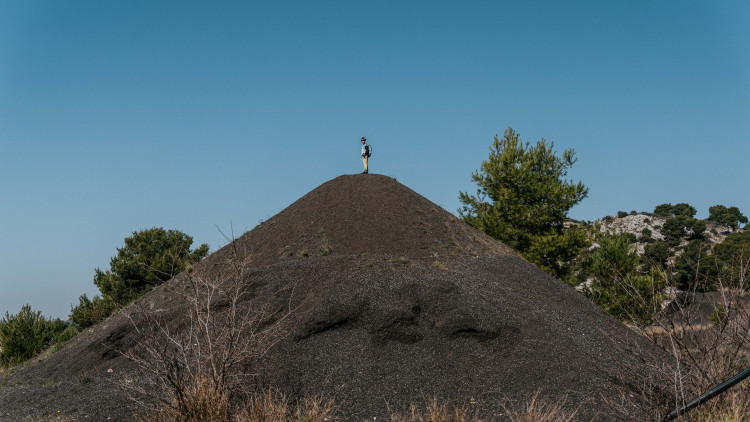
Developed across three territories shaped by industrial decline, agricultural exploitation and energy overconsumption — Barruelo de Santullán (Palencia, Spain), Wietstock (Ludwigsfelde, Germany) and Šibenik (Šibenik-Knin County, Croatia) — ALILAND explores the transformative potential of contemporary art in addressing environmental and territorial challenges.
Bringing these experiences together, the closing event offers an opportunity to celebrate the results of the process, share its outcomes and reflect on the possibilities of art as a tool for territorial and ecological transformation.
Taking place over three days and in two different cities, the event will bring together artworks, publications and conversations. Discover the full programme below.
PROGRAM
ZAGREB, November 27, 2026 at 6 pm
Association of the Croatian Architects, Trg bana Josipa Jelačića 3/I, Zagreb
6 – 7.30 pm Lectures by Maša Štrbac and Elke Krasny
Maša Štrbac: Challenges in the Implementation of New Patrons Projects in Zagreb - the Case-study of "Let's Renew a Well" project
"Let’s Renew a Well" was initiated by Open Art Drive in October 2023 in response to Gornji Stenjevec residents’ call to restore public wells. Through two public forums, residents selected a well for renovation, while architecture students presented design proposals based on their needs. Developed using the New Patrons methodology, the project aims to bring residents’ aspirations to the attention of city authorities and explore pathways to implementation. The presentation examines the project’s progress to date, alongside the legal frameworks, opportunities and challenges involved.
Elke Krasny: Reanimating Land – Working with Critical Care
What does it mean to care for land in a world organized around violence against land? As land is increasingly subjected to geopolitical conquest, colonial dispossession, capitalist extraction, and ecological ruination, this lecture challenges the hegemonic imaginaries that render land passive, inanimate, and available for appropriation. It begins from a fundamental proposition: humans are land-bound beings, materially, bodily, and existentially inseparable from the land that sustains them. Violence against land is therefore never only violence against an external environment; it is violence against the conditions of life itself, affecting human and more-than-human bodies, communities, and futures.
Mobilizing critical care at the intersection of feminist care theory, critical theory, and the imperative to sustain life in crisis, the lecture develops the idea of the necropolitics of land to examine how colonial, capitalist, and imperial regimes produce death-worlds through the appropriation, depletion, and destruction of land. Land is not merely the stage upon which history unfolds, but a material archive that stores the histories of violence and care in its soils, infrastructures, sediments, and ecologies. To care for land critically requires learning to read these histories and to understand the changing needs of land in response to the violence inscribed in its material existence.
Against the masculinist hubris of mastery and the promise of technocratic quick fixes, the lecture turns to land cares: plural, situated, and sustained practices of stewardship, regeneration, collective organizing, and ecological reciprocity. Drawing on Indigenous epistemologies, communitarian feminisms, and relational cosmologies, it foregrounds forms of knowing and inhabiting land that refuse the separation of human bodies from territories and challenge the extractive logics of ownership, control, and commodification. Such land cares are not peripheral responses to environmental crisis, but vital practices of resistance and life-making. They open onto a radical proposition: land has rights not only as territory claimed by human communities, but as a living entity with its own right to exist, flourish, and participate in shaping the conditions of its care. The rights of land and the rights to land thus converge as rights to care. Reanimating land becomes a critical and material practice of restoring its vitality, while reimagining the conditions under which land-bound beings can live and flourish together.
7.30 – 8.30 pm Presentation of the book REPAIR THE LAND: Tools from the Art World for the Future
With participation of the authors Susanne Burmester, Elke Krasny, Sonja Leboš, and Fran Quiroga, the editor Petra Šarin and coordinator of the project Alicia Ruiz Muñoz.
ŠIBENIK, 28-29 November 2026
November 28, 5 – 6 pm
Croatian National Theatre Šibenik, Ul. Kralja Zvonimira 1, Šibenik
Lana Stojićević and collaborators: TOWARDS THE MANGAN CITY, performative multimedia installation
Through stagings in dominantly anthropomorphic and sculptural costumes that represent personified problems of Šibenik’s social post-industrial reality, Lana Stojićević presents her interpretation of the recent history of Šibenik’s Crnica neighbourhood.
Collaborators: Duje Kundić, cinematographer, creative assistant director, editor, sound designer; Katja Grcić, dramaturge; Pavle Mijuca, performer, co-screenwriter; Sunčica Bandić, Mia Kevo, Kristina Lovrić, performers; Tanja Barić, Ivana Vukušić, stilt performers; Tony Marasović, drone operator ; Filip Gavranić, Juraj Zvonimir Knezović, camera assistants; Frane Duilo, musician; Nikola Križanac, graphic designer; Glorija Lizde, photographer; Božena Spahija, seamstress; Oriana Kunčić, drama pedagogue.
November 29
11 am – 1 pm
Public walk: How the industry shaped the city (led by the architect Ana Selak and Dario Crnogaća). Meeting Point: in front of the Croatian National Theatre Šibenik.
Post-war Šibenik was marked by industrialization, which significantly altered the city's existing appearance. This walking tour will explore the extent of its impact on urbanization and residential development, with the aim of highlighting the city's industrial heritage from the second half of the 20th century.
6 pm – 10 pm
CLUB AZIMUT, Obala palih omladinaca 2, Šibenik
6 – 6.30 pm
Conversation between Elke Krasny and Jelena Kupsjak on the concepts of Ana L. Tsing
7 – 8.30 pm
Presentation of the book REPAIR THE LAND: Tools from the Art World for the Future
With participation of the authors Susanne Burmester, Elke Krasny, and Sonja Leboš, the editor Petra Šarin and the guest respondent Jelena Kupsjak.
9 – 10 pm
Reception